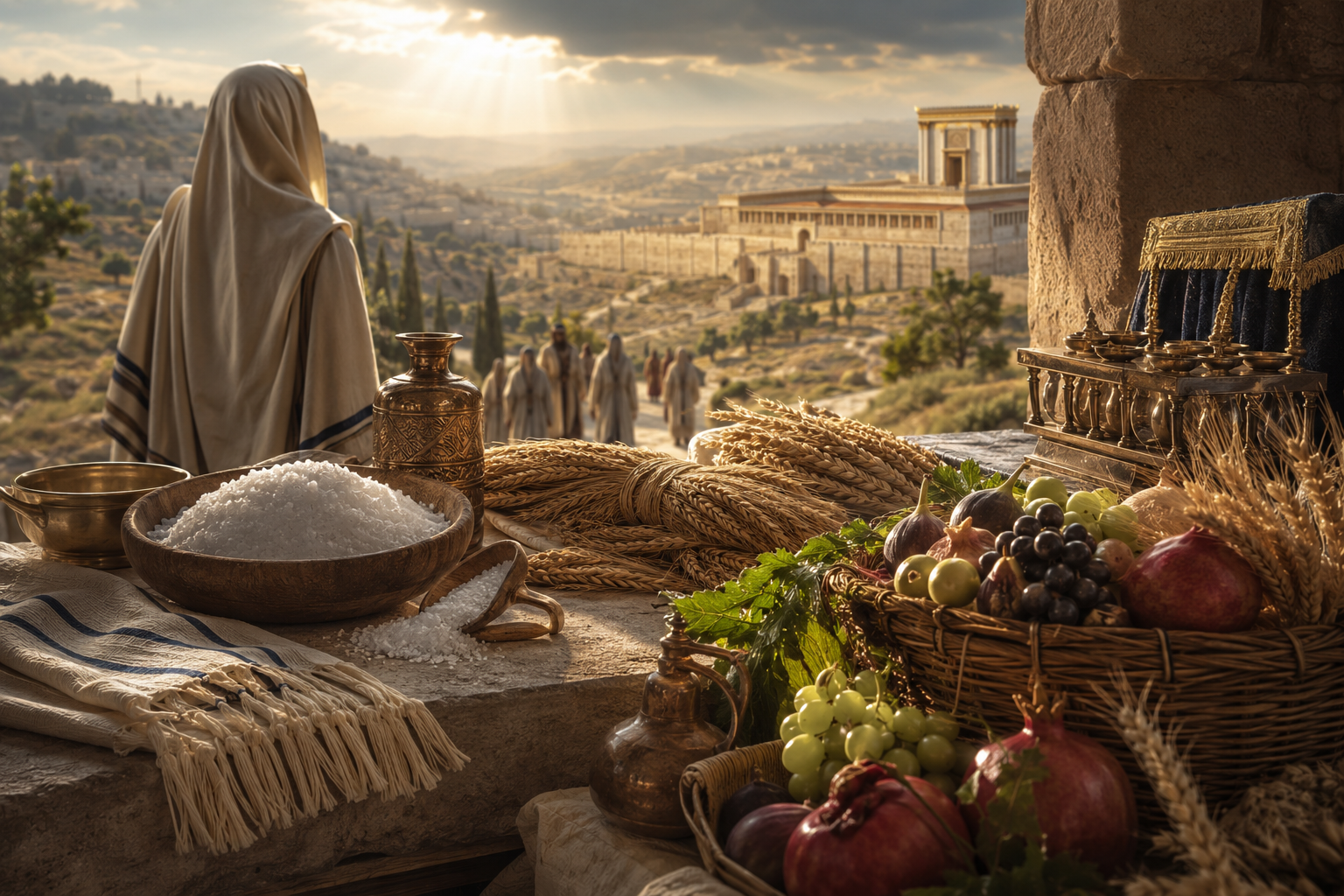
The Covenant of Salt, First Fruits, and Life in "Diasporaville"
What exactly is the Covenant of Salt? And if first fruits belong to the priests, how would Jews living far from Jerusalem fulfill the command? These practical questions open the door to a fascinating exploration of priesthood, covenant permanence, the Diaspora, and the future restoration of Temple worship.
One of our students recently asked a pair of questions that perfectly illustrate why Torah study can sometimes feel like assembling a puzzle from pieces scattered throughout Scripture.
The questions were simple:
What exactly is the Covenant of Salt?
And if first fruits belong to the priests, how would people living far away bring them before they spoiled? What happens for those of us living in the Diaspora?
These are excellent questions because they force us to think beyond isolated verses and begin seeing the Torah as a living system.
The Covenant of Salt
The phrase "Covenant of Salt" appears in connection with the priesthood and with the kingdom of David. In Numbers 18, after outlining the portions that belong to Aaron and his descendants, God declares:
"It is a covenant of salt forever before the LORD for you and your offspring with you." (Numbers 18:19)
The covenant itself is not made of salt. Rather, salt functions as a symbol.
In the ancient world, salt preserved food from corruption. Because of this, salt became a fitting symbol for permanence, endurance, and faithfulness. A "covenant of salt" is therefore a covenant intended to endure.
This symbolism is reinforced in Leviticus 2:13:
"You shall season all your grain offerings with salt."
Notice that the command is not merely to add salt to one specific offering. Salt is associated with all the offerings because it represents the enduring nature of the relationship between God and His people.
The priesthood is enduring. The Davidic kingdom is enduring. God's covenant promises are enduring. Salt becomes the visible reminder of that truth.
What Is Burned and What Is Given to the Priests?
One reason many readers become confused is that different sacrifices function differently.
Some offerings are entirely consumed on the altar. Others are partially burned and partially eaten. Others provide portions for the priests.
The grain offering, for example, has a memorial portion burned before God while the remainder belongs to the priests.
The peace offering is shared between God, the priests, and the worshipper in a covenant meal.
The burnt offering is consumed entirely upon the altar.
The priestly portions listed in Numbers 18 include offerings, first fruits, and various dedicated gifts. The Covenant of Salt specifically confirms the enduring right of the priesthood to receive those holy portions.
The First Fruits Question
The second question is perhaps even more interesting.
If first fruits belong to the priests, what happened when someone lived a great distance from Jerusalem?
Wouldn't the produce spoil before arriving?
The Torah itself recognizes that distance creates practical challenges. Certain commandments include provisions for those living far from the sanctuary. However, first fruits are closely connected to the land and to the place where God causes His name to dwell.
This reminds us that many Torah instructions are not universal in location. Some commandments apply wherever God's people live. Others are tied specifically to the land of Israel. Others require the Temple itself.
This distinction is often overlooked by modern readers.
Levites as "Satellite Temples"
An interesting observation is that the Levites were intentionally scattered throughout Israel.
Before the Temple was established, local priestly and Levitical ministry played an important role in preserving Torah instruction among the tribes.
This raises a fascinating possibility.
Could the presence of Levites throughout the land have functioned as a practical extension of Jerusalem's ministry?
While Scripture does not explicitly call them "satellite temples," their distributed presence ensured that Torah teaching and priestly service were never completely disconnected from daily life.
What About the Diaspora?
Today many believers and Jews live outside the land of Israel.
If Temple worship is restored in the future, how will certain commandments function for those living thousands of miles away?
The honest answer is that we do not know every detail.
Some aspects appear straightforward. Modern transportation makes movement of people and goods easier than at any point in history.
Other issues may require formal rulings by future religious authorities.
Historically, difficult questions were often addressed through deliberation and legal decisions by recognized leadership. It is reasonable to assume that practical questions surrounding first fruits, priestly gifts, and diaspora participation would receive similar treatment.
Awaiting the King's Wisdom
There is also another perspective worth considering.
Many believers anticipate not merely the restoration of Temple service but the arrival of Messiah Himself.
If that expectation is correct, then some unresolved questions may ultimately await His direct instruction.
The Torah gives us the principles. Future circumstances may require application that has not yet been fully revealed.
For now, these questions remind us that Scripture was given to a real people living in real places with real logistical challenges. The Torah is not merely theology; it is a covenant lived out in the practical realities of everyday life.
And perhaps that is one of the greatest lessons hidden within both the Covenant of Salt and the command concerning first fruits.
God's covenant is eternal, but its faithful application often requires wisdom, patience, and a willingness to wrestle with the details.