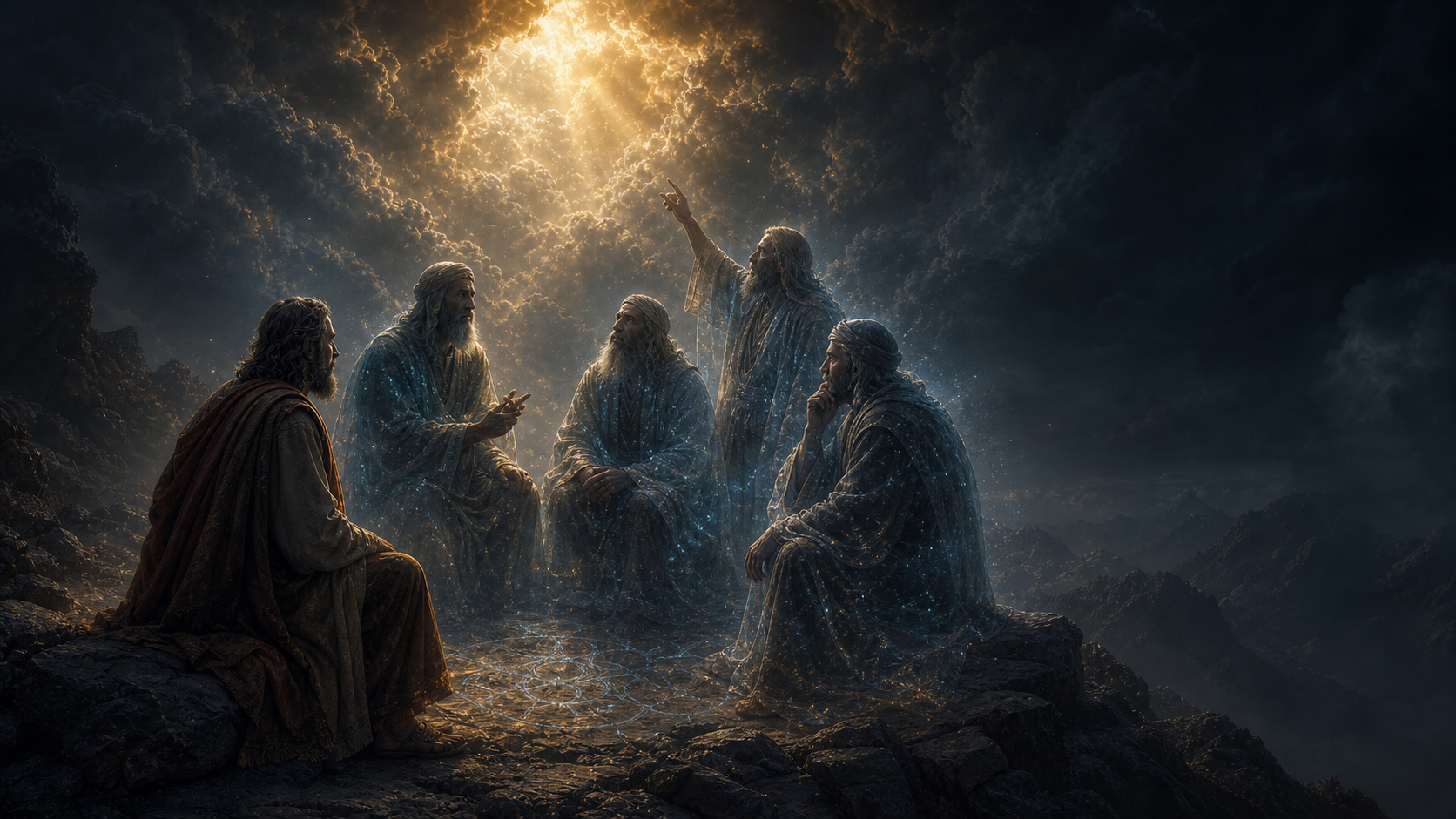
Who spoke to Moses on the Mountain? (PART 1)
Something mysterious happens while Moses spends time atop Mount Sinai. What can we find out about who Moses interacted with and how does it impact how we understand the transmission of Torah? This series of articles will explore those questions.
One of the most important theological premises anyone coming to the God of Israel needs to accept is that He is self-sufficient and self-efficient. This is a simplified way of declaring that Hashem does not lack anything outside of Himself. Any actions Hashem has taken in the past, to commission anyone outside of Himself to do His will, is evidence of His desire to share of Himself, not as a picture of His own "limitation".
While this theological premise undergirds the entirety of any theological consideration, for the sake of this particular blog series, it is going to be used to support the idea that Moses received portions of Torah instructions from supernatural beings, other than Hashem, but undoubtedly commissioned by Hashem.
For those not well versed in general Judaism, the thought of supernatural beings(angels) giving Moses content for the books we call "Torah", can be startling. How startled the reader is, depends on what their upbringing taught them about the interaction of supernatural beings with the natural world.
In simple terms, within Judaism, particularly the mystical considerations of Judaism, it is commonly accepted belief that Moses did not only engage with Hashem to receive Torah.
What may make accepting this difficult for those who are not coming from a traditional Jewish/Israel perspective, is the fact that this reality is not clearly spelled out within Tanakh(Genesis - Malachi). That does not make the claim false though.
In fact, the irony is that in the writings I teach my students is "Messianic Talmud", namely the Gospels to Revelation, there is evidence of this common Jewish belief! In at least 3 places within the Messianic Talmud(Gospels - Revelation), it is made clear that beings, other than Hashem interacted with Moses to produce the content Israel receives as Torah. This does not have to make anyone drawing near to Israel nervous for a few reasons.
Hashem can and does delegate responsibilities to servants throughout the Tanakh
While my intention is not to make this blog "content heavy", I want to give a very simple example of this premise by pointing out that from Genesis' creation account, we see mankind, concealed in Adam and Eve, taking delegated authority from Hashem in the process of the naming of the animals.
This is of course not because Hashem was, Himself incapable of taking care of this process.
Delegating does not need to mean diluting the value
While it is possible for a spokesperson to tamper with the message they have been instructed to pass along, there is no reason to condemn the process of reciting a message on behalf of the sender. In our day and age, ambassadors between countries prove that a president can and does in fact, send a delegate to speak on behalf of the government of a country in foreign spaces.
We know this principal is played out in the roles of prophets in scripture too.
Delegating can and in this case, does in fact show the relationship between Hashem and his highest ranking servants in Eternity
This particular example, is the most critical, for the sake of this particular theological exploration.
While some versions of the gospel reduce the role of supernatural beings to little more than FedEx couriers for Hashem, the reality within Judaism is far more complex than that. The complexity is necessary, not to stroke the ego of the supernatural beings around Hashem's throne, but rather to establish the fully comprehendible reach of "holiness" of Hashem, which is shown to be true because of the intermediary role of the supernatural entities we most commonly call "angels".
What this suggests is that the idea of "angels" sharing Torah instructions with Moses does not at all diminish the authority of Hashem, nor as noted previously, His holiness, but in fact, it amplifies both.
In part 2 of this series, we will need to slow the panoramic view of this topic down and focus in on the claims of this blog so as to give a better appreciation of why it makes perfect sense that Hashem was not in fact the only one to speak to Moses on the mountain.
See you at Part 2!